
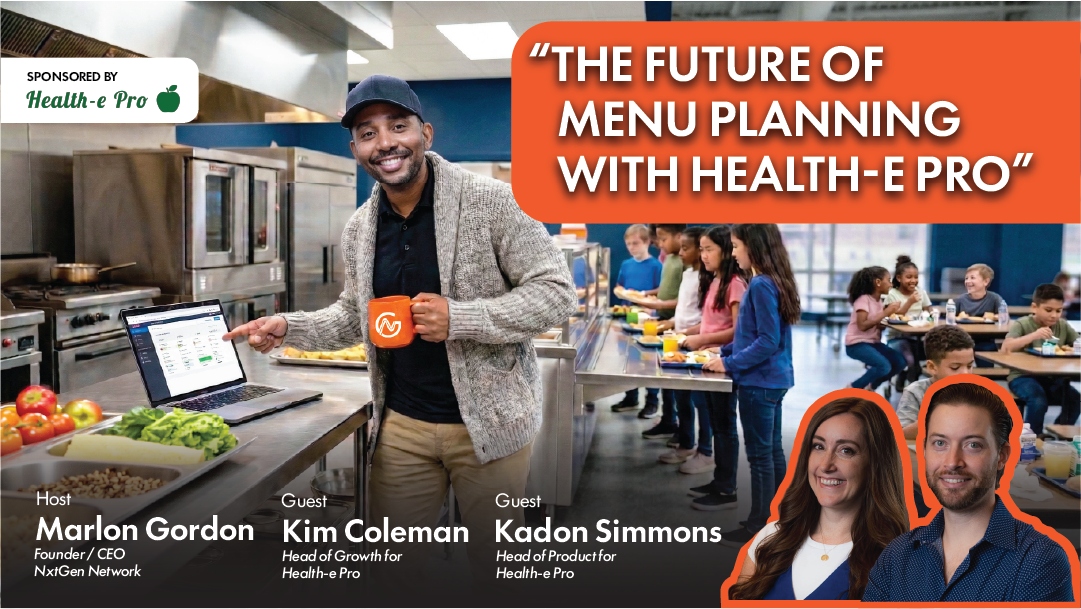
The Menu Drives Everything
In school nutrition, almost every operational decision flows from one document: the menu. Ordering, production records, USDA compliance, cost tracking, staff scheduling — it all starts with what's on the menu. Which makes it stunning that for years, most school nutrition directors were building those menus in spreadsheets, or with software so clunky it required a full training program just to enter a recipe.
That gap is exactly what Health-e Pro was built to close. Founded by Meg Chesley, a retired school nutrition director who spent decades on the front lines of K-12 food service, Health-e Pro is a cloud-based, USDA-approved menu planning platform with over 5,000 recipes, 20,000 products, and a team that includes registered dietitians and food service professionals who have lived the job. It is not software built by engineers who learned about school nutrition from a brief. It is software built by people who ran the programs.
On this episode of Next Up Podcast, host Marlon Gordon sat down with Kadon Simmons, Head of Growth, and Kim Coleman, Head of Product at Health-e Pro, to pull back the curtain on how a consulting side hustle became a 30-person company that school districts refuse to leave.
Built From the Inside Out
The founding story matters here. Meg Chesley did not leave the school nutrition world and then decide to build software. She built the software because she kept wishing it existed. That distinction shows up throughout the product. Health-e Pro is not optimized for demos or feature checklists — it is optimized for the workflow of a nutrition director who is managing compliance, tracking commodities, updating production records, and fielding calls from a principal about a menu change, all before 9 AM.
Kim Coleman, who leads product development, spoke about this directly. The goal is not to make software that your team uses constantly — it is to make software that does the heavy lifting so your team spends less time in it. Every feature is evaluated against that question: does this reduce the burden on the person running the program, or does it add steps? That philosophy is rare in enterprise software, and it explains why districts who adopt Health-e Pro tend to stay.
5,000 Recipes, 20,000 Products — and the Compliance Layer Underneath
The scale of the Health-e Pro database is one of the platform's clearest differentiators. Over 5,000 USDA-creditable recipes and more than 20,000 products give nutrition directors the building blocks to plan compliant menus without starting from scratch each cycle. The platform handles the crediting math automatically — no more manually cross-referencing the nutrition facts panel against USDA meal pattern requirements.
Kadon Simmons described this as removing the "compliance anxiety" that sits underneath every menu decision. When a director adds a new item or substitutes an ingredient, the system flags any crediting issues immediately. That kind of real-time feedback loop is the difference between catching a problem in the planning stage versus discovering it during a state review.
"The menu drives everything else in your operation."
Commodities, Manufacturers, and the K-12 Supply Chain
One of the more nuanced conversations in the episode was about the role of commodity products and manufacturer relationships in K-12 food service. School districts receive significant USDA commodity entitlements — value-added products, bulk commodities, and direct-ship items — and managing how those flow into the menu planning process is a real operational challenge.
Health-e Pro has built integrations and product data pipelines that account for commodity items alongside commercial products, giving nutrition directors a single planning environment rather than a patchwork of spreadsheets and vendor portals. Simmons noted that manufacturer relationships are critical here — accurate product data, up-to-date nutrition information, and seamless spec sheets all feed into the platform's database, and Health-e Pro works directly with manufacturers to keep that data current.
AI Is Coming to School Nutrition Compliance
Coleman was candid about what is next for the platform: artificial intelligence applied to compliance checking and recipe suggestions. The vision is a system that can look at a district's menu cycle, flag nutritional gaps before they become audit findings, and surface recipe alternatives based on what the district already has in inventory or what commodities are available that month.
For districts dealing with tight budgets and smaller teams, that kind of intelligent assistance is not a luxury — it is a multiplier. A single nutrition director managing multiple schools cannot manually audit every menu line for compliance. AI that does that background work continuously changes the math on what a small team can accomplish.
Why the Best People in School Nutrition Are Lifers
The conversation also touched on something that does not get said enough in K-12 food service: the people who stay in this industry are extraordinary. Simmons and Coleman both described school nutrition as a field that attracts people with genuine mission orientation — they are there because they believe in what school meals mean for kids, not because it was the highest-paying option on the table. That culture creates a customer base that is deeply knowledgeable, highly demanding, and extraordinarily loyal when a vendor actually delivers.
It also means that software built by outsiders tends to fail. The institutional knowledge required to serve this market well is hard-won. The Health-e Pro team's credibility with school nutrition directors comes directly from the fact that Meg Chesley and the team around her have earned those relationships the hard way — by knowing the work from the inside.
Why Districts Who Use It Refuse to Leave
Retention in enterprise SaaS is usually driven by switching costs — how painful is it to migrate your data somewhere else? Health-e Pro's retention is different. Districts stay because the software genuinely saves them time and reduces stress. When you have a tool that eliminates hours of compliance work each week, that has the right recipes pre-loaded, that connects to your commodity inventory, and that your dietitian helped design — you do not go looking for alternatives.
That is the moat Meg Chesley built: not a contract, but a product that is actually better than the alternative. In an industry where trust is everything and relationships last decades, that approach compounds.
Watch the Full Episode
The full conversation with Kadon Simmons and Kim Coleman covers the founding story in detail, the product roadmap, how Health-e Pro is expanding its manufacturer partnerships, and what the team thinks the next five years look like for technology in school nutrition. It is one of the most grounded, operationally honest conversations we have had on Next Up.
Watch "Menu Drives Your Business: Inside Health-e Pro's Mission to Save Menu Planners Time" on YouTube — or find Next Up Podcast on Spotify and Apple Podcasts.